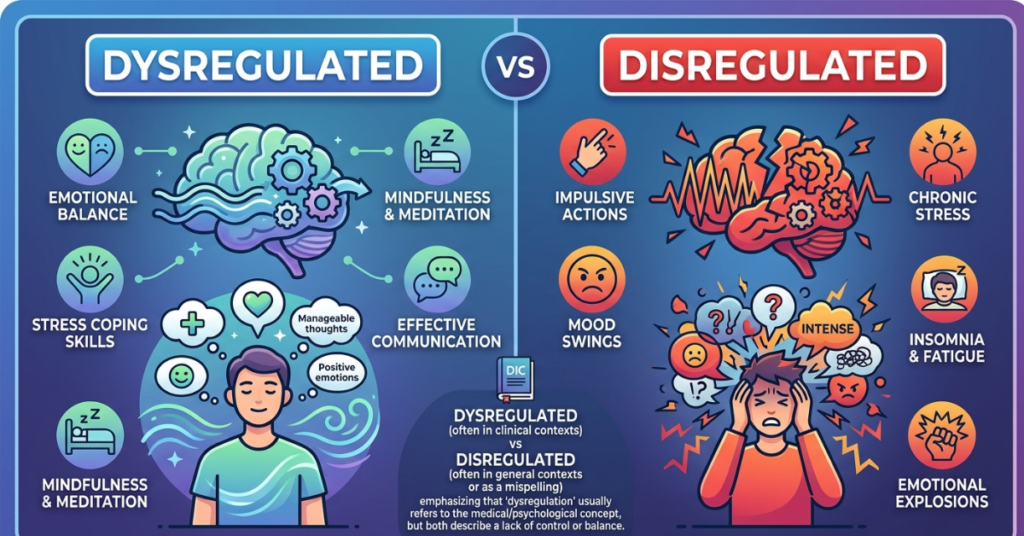

Have you ever seen someone describe themselves as “dysregulated” and wondered whether “disregulated” means the same thing? The two words look remarkably similar, and it is easy to assume they are simply alternative spellings. However, dysregulated vs disregulated is a little more nuanced than that.
In modern English, dysregulated is the much more established and widely used term, particularly in psychology, medicine, neuroscience, and discussions about emotional regulation. Disregulated does exist, but it is considerably less common and can have different usage depending on the context.
Understanding the distinction can help you choose the right word, especially when discussing emotional regulation, behavior, stress responses, or physiological processes.
Dysregulated vs Disregulated: The Quick Answer
If you are wondering which term you should generally use, dysregulated is usually the better choice.
- Dysregulated: Commonly means that a regulatory process is not functioning normally or is poorly controlled.
- Disregulated: A real but less common word that can mean disturbed, disrupted, or no longer properly regulated.
- In psychology: “Emotionally dysregulated” is the standard expression.
- In everyday writing: “Dysregulated” is generally more recognizable and natural.
So, if you are talking about someone’s emotional state, stress response, nervous system, or difficulty managing emotions, dysregulated is normally the appropriate term.
What Does Dysregulated Mean?
Dysregulated describes a system or process whose normal regulation is impaired, disrupted, or functioning atypically.
The word is built around the prefix dys-, which is commonly used to indicate something that is difficult, abnormal, impaired, or not functioning properly.
For example:
“She felt emotionally dysregulated after the stressful conversation.”
This suggests that the person’s usual ability to manage or regulate their emotional response was disrupted.
The word can describe much more than emotions. It may be used when discussing:
- Emotional regulation
- Stress responses
- The nervous system
- Sleep patterns
- Hormonal processes
- Appetite and eating behavior
- Attention and behavior
- Physiological systems
Importantly, calling someone dysregulated does not necessarily mean that something is permanently wrong with them. Regulation can fluctuate depending on stress, environment, sleep, relationships, and other circumstances.
What Does Disregulated Mean?
Disregulated is also used in English, although it is much less common than dysregulated in many modern contexts.
The prefix dis- can convey separation, reversal, removal, or disturbance. As a result, disregulated can be understood as something that has been disturbed or moved away from a regulated state.
For example, someone might use the word to describe a system whose normal regulation has been disrupted.
However, in contemporary psychological writing, dysregulated is generally the more established and familiar choice.
This is one reason people searching for “dysregulated vs disregulated” may encounter conflicting explanations: both forms can appear in real-world usage, but they are not equally common or equally preferred in every field.
Is Dysregulated or Disregulated Correct?
In most situations, dysregulated is the safer and more conventional choice.
If you are writing about psychology, emotional responses, mental health terminology, neuroscience, or behavior, dysregulated is especially appropriate.
For example:
- Correct and natural: “He became emotionally dysregulated.”
- Less common: “He became emotionally disregulated.”
The second sentence may be understandable, but the first is far more consistent with contemporary psychological terminology.
That said, language depends on context. Disregulated is not simply a meaningless misspelling. It appears in various forms of writing and can be used when the intended meaning is that regulation has been disrupted.
Why Do People Confuse Dysregulated and Disregulated?
The confusion largely comes from the fact that both words appear to describe the opposite of being properly regulated.
There is also a subtle difference in how their prefixes work.
The meaning of “dys-”
The prefix dys- generally suggests something abnormal, impaired, difficult, or faulty.
Examples include:
- Dysfunctional
- Dysphagia
- Dyslexia
- Dysfunction
Therefore, dysregulated naturally conveys the idea of regulation that is impaired or not working properly.
The meaning of “dis-”
The prefix dis- can suggest separation, reversal, absence, or disturbance.
Because of this, disregulated can be interpreted as regulation that has been disrupted or disturbed.
The overlap in meaning makes the two words easy to confuse, particularly in informal writing.
Emotional Dysregulation: The Most Common Usage
One of the most common places you will encounter dysregulated is in the phrase emotional dysregulation.
Emotional dysregulation refers broadly to difficulty managing or modulating emotional responses. A person experiencing emotional dysregulation may find that their emotions feel unusually intense, last longer than expected, or are difficult to bring back to a manageable level.
For example, a relatively small disagreement might trigger a very strong emotional reaction, followed by difficulty calming down.
Possible experiences can include:
- Intense anger
- Sudden sadness
- Feeling overwhelmed
- Difficulty calming down
- Strong reactions to stress
- Emotional reactions that feel difficult to control
However, experiencing these reactions occasionally does not automatically mean someone has a mental health disorder. Everyone can become emotionally overwhelmed, particularly during periods of stress, exhaustion, grief, or major life changes.
What Does It Mean to Be Dysregulated?
When people say they are dysregulated, they often mean that they feel overwhelmed and that their normal ability to respond calmly or effectively has temporarily been disrupted.
For example, after a stressful day, someone might say:
“I’m completely dysregulated today.”
In casual conversation, this may simply mean:
- “I feel overwhelmed.”
- “I can’t calm down.”
- “Everything feels like too much.”
- “I’m having trouble managing my emotions.”
- “My stress response feels intense.”
The word has become increasingly common in everyday conversations about stress and emotional wellbeing.
Dysregulated vs Disregulated in Psychology
In psychology and related fields, dysregulated is the term you are most likely to encounter.
Researchers and clinicians may discuss concepts such as:
- Emotional dysregulation
- Behavioral dysregulation
- Self-regulation difficulties
- Affective dysregulation
- Physiological dysregulation
The precise meaning depends on the research area. “Dysregulated” should therefore not be treated as a diagnosis by itself.
For example, describing someone as emotionally dysregulated does not automatically identify the cause of their emotional difficulties. Similar experiences can occur for many different reasons.
Dysregulated vs Unregulated: Are They the Same?
Not quite.
Unregulated generally means that something is not being regulated or controlled.
Dysregulated usually suggests that an existing regulatory process is impaired, disrupted, or functioning atypically.
Consider these simplified examples:
- Unregulated: A process has little or no regulation.
- Dysregulated: A regulatory system exists but is not functioning normally.
The distinction can be subtle, and the exact meaning depends on the field in which the words are being used.
Examples of Dysregulated in a Sentence
Here are several natural examples:
- “After several stressful weeks, she felt emotionally dysregulated.”
- “Poor sleep can affect how a person responds to stress.”
- “The study examined dysregulated physiological responses.”
- “He needed some quiet time because he felt overwhelmed and dysregulated.”
- “The researchers investigated mechanisms involved in emotional dysregulation.”
These examples show why dysregulated is useful across both technical and everyday contexts.
Examples of Disregulated in a Sentence
Although less common, disregulated can also appear in writing:
- “The process became disregulated after the external disturbance.”
- “The system was described as disregulated following the disruption.”
Whether this wording is preferable depends on the discipline, publication, and intended meaning. In many psychological contexts, replacing it with dysregulated would sound more conventional.
Dysregulated vs Disregulated: Comparison Table
| Feature | Dysregulated | Disregulated |
| Common in modern usage | Yes | Less common |
| Used in psychology | Very common | Uncommon |
| Refers to impaired regulation | Yes | Can |
| Refers to disrupted regulation | Yes | Yes |
| Common phrase | Emotional dysregulation | Less established |
| Best general choice | Usually | Depends on context |
How to Remember the Difference
A simple memory trick is to associate dys- with something functioning abnormally.
Think:
Dysregulated = regulation isn’t working properly.
If you’re talking about emotional regulation, stress responses, behavior, or a physiological system that isn’t regulating normally, dysregulated will usually be the word you want.
Why “Dysregulated” Is So Common Today
The growing popularity of the term is partly connected to increased public discussion of emotional regulation, stress, trauma, neuroscience, and mental wellbeing.
Social media has also made psychological vocabulary more common in everyday conversation. Words that were once mainly used in academic or clinical settings can now appear in discussions about relationships, work, parenting, anxiety, burnout, and personal wellbeing.
As a result, phrases such as “I feel dysregulated” have become familiar to many English speakers.
Still, popular usage should not be confused with a clinical diagnosis. The word describes a state or pattern of regulation; it does not, by itself, explain why that state is occurring.
Is “Dysregulated” a Medical Diagnosis?
No. Dysregulated is a descriptive term rather than a diagnosis by itself.
A healthcare professional may use language involving dysregulation when describing a person’s symptoms or a biological process, but the word alone does not establish a particular disorder.
This distinction matters because emotional overwhelm can happen to anyone. Stress, lack of sleep, conflict, major changes, and difficult experiences can all affect a person’s ability to regulate emotions.
Which Word Should You Use?
If you are unsure between dysregulated vs disregulated, consider the context.
Use “dysregulated” when:
- Writing about emotional regulation
- Discussing psychology or neuroscience
- Describing a disrupted regulatory process
- Talking about stress responses
- Writing for a general audience
- Referring to emotional dysregulation
Consider “disregulated” when:
- You are following terminology from a particular technical source
- The intended meaning specifically emphasizes disrupted regulation
- The field or publication you are writing for uses the term consistently
When writing for a general audience, however, dysregulated will usually be clearer and more familiar.
Frequently Asked Questions
Is dysregulated the correct word?
Yes. Dysregulated is a well-established English word and is particularly common in psychology, medicine, neuroscience, and discussions about emotional regulation.
Is disregulated a real word?
Yes, disregulated does appear in English usage. However, it is much less common in many contemporary contexts, especially when discussing emotional or psychological regulation.
Is dysregulated the same as emotionally overwhelmed?
Not exactly. Someone who feels emotionally overwhelmed may be experiencing temporary difficulty regulating their emotions, but “dysregulated” is a broader descriptive term and does not necessarily mean the same thing in every context.
What does emotionally dysregulated mean?
Emotionally dysregulated generally means having difficulty modulating or managing emotional responses. Emotions may feel unusually intense, prolonged, or difficult to bring back to a manageable level.
Can you say “I am dysregulated”?
Yes. In informal conversations, people increasingly use “I’m dysregulated” to describe feeling overwhelmed, overstimulated, stressed, or unable to settle emotionally.
Which is more common: dysregulated or disregulated?
Dysregulated is generally much more common, particularly in psychological and mental-health-related writing.
Is dysregulated a negative word?
Not necessarily. It describes a state or pattern of regulation rather than judging someone’s character. A person can become dysregulated temporarily and later return to a more regulated state.
What is the opposite of dysregulated?
Depending on the context, possible contrasts include regulated, well-regulated, or effectively regulated. “Regulated” is generally the simplest opposite.
Final Takeaway: Dysregulated vs Disregulated
When comparing dysregulated vs disregulated, the main takeaway is simple: dysregulated is the more established and widely used term, especially when discussing emotions, stress, behavior, neuroscience, or physiological regulation.
Disregulated is not necessarily meaningless or impossible, but it is considerably less common and may sound unusual to many readers. If you’re writing for a general audience and want the clearest, most familiar wording, dysregulated is usually the better choice.
When you encounter either term, look beyond the spelling and consider the context. Understanding how the word is being used is often more important than treating the two forms as completely interchangeable.