

Have you ever typed “perfer” and then paused because it looked a little strange? You’re not alone. Prefer or perfer is a common spelling question, especially because the two forms look almost identical when written quickly.
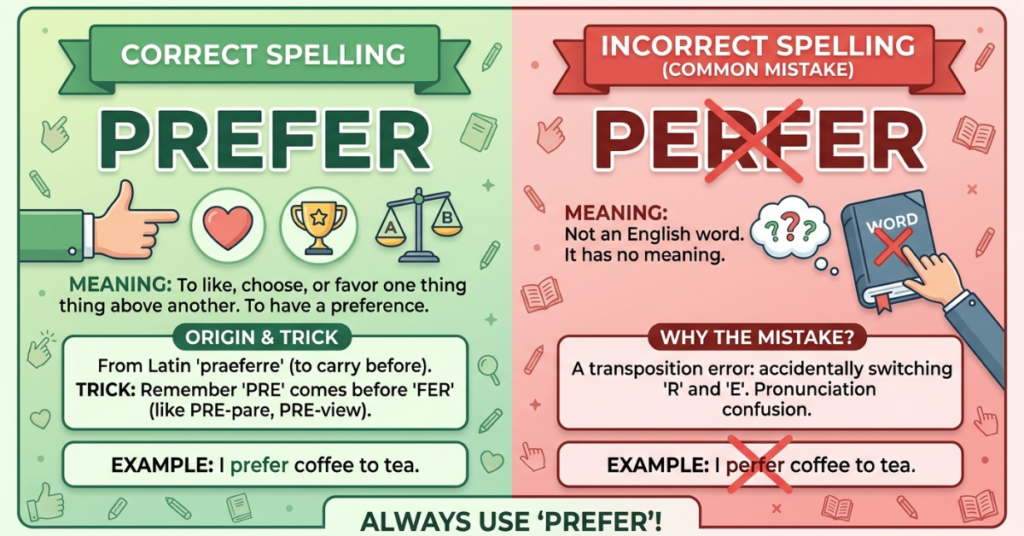
The correct spelling is prefer. “Perfer” is a misspelling and is not considered standard English. The word prefer is a verb used when you like, choose, or favor one thing over another.
In this guide, we’ll look at the prefer or perfer spelling, meaning, pronunciation, grammar, examples, and a few easy ways to remember which version is correct.
Prefer or Perfer: Which One Is Correct?
If you’re wondering, “is it prefer or perfer?”, the answer is simple:
Prefer is correct.
Perfer is incorrect.
The correct word contains an “e” after the “r” sound:
P-R-E-F-E-R → prefer
There is no standard English word spelled “perfer.” If you see it in a text, email, assignment, or social media post, it is most likely a spelling mistake.
Prefer vs. Perfer at a Glance
| Word | Correct? | Meaning |
| prefer | Yes | To like or choose one thing more than another |
| perfer | No | Common misspelling of “prefer” |
So, if you’re asking “prefer or perfer?”, always choose prefer.
Prefer or Perfer Meaning
The prefer or perfer meaning question usually comes down to understanding the word prefer.
Prefer means to like, want, or choose one person or thing more than another.
For example:
- I prefer tea to coffee.
- She prefers working in the morning.
- We prefer the blue design.
- He prefers staying at home on weekends.
When you say that you prefer something, you’re expressing a personal choice or preference.
What Does Prefer Mean in Simple English?
In simple terms, prefer means “like better.”
For example:
I prefer cats to dogs.
This means:
I like cats more than dogs.
Another example:
She prefers summer to winter.
This means she likes summer more than winter.
The word is useful in everyday conversations because it allows you to talk naturally about your choices and preferences.
Is It Prefer or Perfer?
If you’re searching “is it prefer or perfer?”, remember that prefer is the only standard spelling.
A common reason people write perfer is pronunciation. In normal conversation, the first vowel in prefer may not sound especially prominent, which can make the spelling confusing.
However, when writing the word, don’t drop the first e.
Correct:
- I prefer chocolate ice cream.
- Do you prefer tea or coffee?
- She prefers modern furniture.
- They preferred the original design.
Incorrect:
- I perfer chocolate ice cream.
- Do you perfer tea or coffee?
- She perfers modern furniture.
The incorrect form may be understandable to readers, but it should still be avoided in formal and professional writing.
Prefer or Perfer Spelling: Why Is “Prefer” Correct?
The correct prefer or perfer spelling is prefer because that is the established spelling of the English verb.
The word comes through Middle English and Anglo-French from Latin praeferre, meaning roughly “to carry before” or “to set before.” Over time, it developed into the modern English verb prefer.
The spelling may seem unusual at first, but knowing its structure can help:
pre + fer = prefer
Think of the word as beginning with “pre”, not “per.”
Is the Word Prefer or Perfer?
The word is prefer.
If you’re completing an assignment, writing an email, preparing a résumé, or posting online, use prefer.
For example:
“I prefer working independently.”
Not:
“I perfer working independently.”
The same spelling applies when the word changes form:
- prefer — present/base form
- prefers — third-person singular
- preferred — past tense
- preferring — present participle
- preference — noun
Notice that these words are all built around pref-, not perf-.
How to Use Prefer Correctly
Knowing the spelling is only part of the answer. It’s also useful to understand how prefer works in a sentence.
1. Prefer + Noun
Use prefer when expressing a preference for something.
I prefer tea.
She prefers modern furniture.
They prefer quiet places.
2. Prefer A to B
One of the most common structures is:
prefer + A + to + B
Examples:
I prefer tea to coffee.
She prefers summer to winter.
He prefers working from home to commuting.
A common mistake is using “than” instead of “to” after prefer in this structure.
Incorrect: I prefer tea than coffee.
Correct: I prefer tea to coffee.
3. Prefer + -ing Form
You can use a gerund after prefer when talking about activities.
I prefer reading before bed.
She prefers walking in the evening.
They prefer eating at home.
4. Prefer to + Verb
You can also use prefer to followed by a base verb.
I prefer to walk.
He prefers to work alone.
We prefer to arrive early.
This structure is especially common when discussing personal habits or choices.
Prefer vs. Preference
Another useful distinction is between prefer and preference.
Prefer is a verb.
I prefer blue.
Preference is a noun.
Blue is my preference.
Both relate to choosing or liking one option more than another, but they have different grammatical roles.
Examples
- Verb: I prefer coffee.
- Noun: My preference is coffee.
- Verb: She prefers minimalist interiors.
- Noun: Her preference is minimalist design.
Understanding this difference can make your writing sound more natural.
Prefer Pronunciation
The word prefer is generally pronounced approximately like:
prih-FUR
The exact pronunciation can vary slightly between accents, particularly between American and British English.
The important point is that pronunciation shouldn’t change the spelling. Even if the first vowel sounds weak when spoken, the written word still begins with pre-.
Common Mistakes With Prefer
The most obvious mistake is writing perfer instead of prefer, but there are a few other errors worth knowing.
Mistake 1: Writing “Perfer”
Incorrect: I perfer tea.
Correct: I prefer tea.
Mistake 2: Using “Than” Instead of “To”
Incorrect: I prefer tea than coffee.
Correct: I prefer tea to coffee.
Mistake 3: Confusing “Prefer” With “Rather”
The expressions prefer and would rather can both express choices, but their sentence structures are different.
Compare:
I prefer tea to coffee.
and:
I would rather drink tea than coffee.
Both communicate a preference, but the grammar is different.
Mistake 4: Incorrect Past-Tense Spelling
The past tense is preferred, with a double r:
She preferred the original design.
Not:
She prefered the original design.
This is another spelling detail that can cause confusion.
Prefer vs. Preferred vs. Preferring
The verb changes depending on the tense or grammatical structure.
| Form | Example |
| prefer | I prefer tea. |
| prefers | She prefers tea. |
| preferred | He preferred tea yesterday. |
| preferring | She is preferring a quieter option. |
| preference | Tea is my preference. |
The most important spelling point is that preferred has two r’s before the ending:
prefer → preferred
Similarly:
prefer → preferring
Easy Trick to Remember Prefer
If you frequently type perfer, try this simple memory trick:
Remember “PRE” in Prefer
Break the word into:
PRE + FER
The beginning is “pre,” just like in words such as:
- prepare
- preview
- predict
- prefer
So when you’re unsure whether the word is prefer or perfer, remember:
PRE comes before FER → PREFER
This small trick can make the correct spelling easier to recall.
Why Do People Write “Perfer”?
The misspelling perfer is understandable because English spelling doesn’t always match pronunciation perfectly.
When people speak quickly, the first vowel in prefer can be reduced, making the word sound less like the way it is written. Typing quickly can also cause people to omit the first e.
Other possible reasons include:
- Writing based on pronunciation
- Typing too quickly
- Autocorrect not catching the error
- Confusing the spelling with another word
- Simply forgetting the correct spelling
Regardless of the reason, prefer remains the correct standard spelling.
Prefer or Perfer Examples in Everyday English
Here are some natural examples you can use in conversation and writing:
- I prefer coffee in the morning.
- Do you prefer black or white?
- She prefers working alone.
- We prefer to travel by train.
- He prefers simple designs.
- I prefer this option to the other one.
- They preferred the second proposal.
- Would you prefer tea or coffee?
- She prefers reading rather than watching television.
- My preference is for something simple and practical.
These examples show how flexible the word prefer can be.
Prefer or Perfer in Professional Writing
Using the correct spelling matters more in professional communication.
A spelling mistake in an email, cover letter, résumé, report, or business proposal can make your writing appear less polished. Fortunately, this particular mistake is easy to avoid once you remember the correct form.
For example:
Professional:
I would prefer to schedule the meeting for Monday.
Incorrect:
I would perfer to schedule the meeting for Monday.
When you’re unsure, take a second to check the spelling before sending important written communication.
FAQs About Prefer or Perfer
Is it prefer or perfer?
Prefer is correct. Perfer is a common misspelling and is not the standard English spelling.
What is the prefer or perfer meaning?
Prefer means to like, choose, or favor one thing more than another. For example, “I prefer tea to coffee” means you like tea more than coffee.
Is the word prefer or perfer?
The correct word is prefer, spelled P-R-E-F-E-R.
Is “perfer” a real word?
In standard modern English, perfer is not the correct spelling of the verb meaning “to like or choose more.” It is generally a misspelling of prefer.
How do you spell prefer?
Prefer is spelled:
P-R-E-F-E-R
A useful way to remember it is PRE + FER.
Is “I prefer” grammatically correct?
Yes. “I prefer” is a completely correct construction.
For example:
I prefer working in the morning.
What is the past tense of prefer?
The past tense is preferred, spelled with a double r.
I preferred the first option.
Is it “prefer to” or “prefer than”?
When comparing two things, the standard structure is generally prefer A to B.
I prefer tea to coffee.
For a different construction using would rather, than is used:
I would rather drink tea than coffee.
Conclusion: Prefer or Perfer?
So, prefer or perfer? The answer is clear: prefer is the correct spelling, while perfer is a common spelling mistake.
Prefer means to like, choose, or favor one option over another. You can use it in everyday conversations, professional writing, academic work, and countless other situations.
The easiest way to remember the spelling is to focus on PRE at the beginning:
PRE + FER = PREFER
Once you get used to seeing the correct form, the prefer or perfer confusion becomes much easier to avoid. If you’re working on your English vocabulary, exploring other commonly confused words can also help you write with greater confidence.