
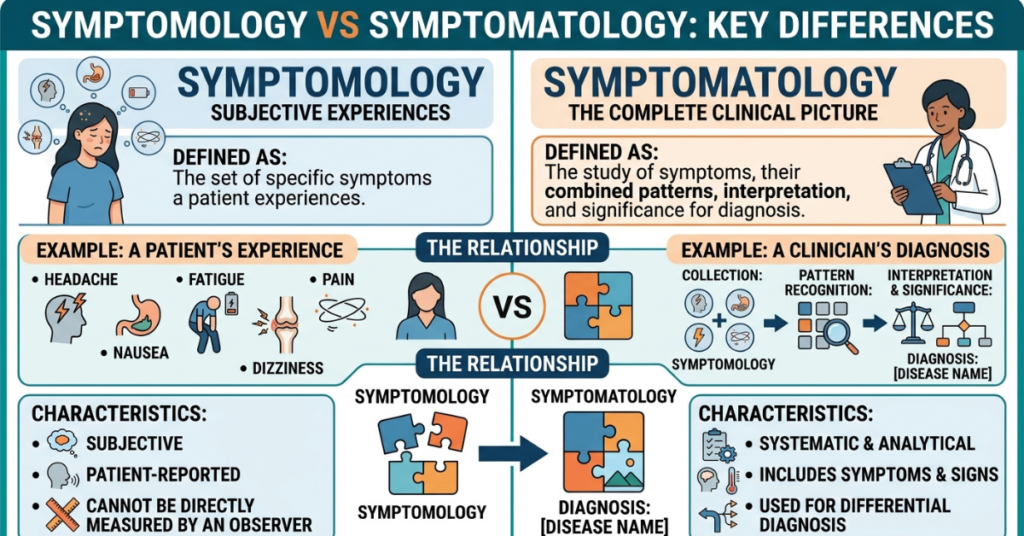

Have you ever seen symptomology vs symptomatology and wondered whether they mean different things—or whether one of them is simply a spelling variation? You’re not alone. These two terms look and sound remarkably similar, and both appear in discussions about disease, symptoms, diagnosis, and medicine.
The short answer is that symptomatology is the more established and formal medical term, while symptomology is generally used as a shortened or informal variant of the same word. Major dictionaries define symptomatology as either the study of symptoms or the collection and pattern of symptoms associated with a disease or patient.
So, is there a real difference between symptomology and symptomatology? Let’s take a closer look.
Symptomology vs Symptomatology: The Quick Answer
In most contexts, symptomology and symptomatology refer to essentially the same idea: symptoms considered collectively or the study of symptoms.
However, there is an important difference in formality and preferred usage.
- Symptomatology: The established medical and academic term.
- Symptomology: A shorter form that is also recognized by some dictionaries, but is generally less formal.
- Meaning: Both can refer to the symptoms associated with a disease or condition, and symptomatology can also refer to the medical study of symptoms.
- Best choice for professional writing: Symptomatology.
Merriam-Webster defines symptomatology as both the symptom complex of a disease and a branch of medical science concerned with disease symptoms. Collins likewise lists symptomology as a form of symptomatology, while defining symptomatology in terms of the study or collective symptoms of disease.
What Does Symptomatology Mean?
Symptomatology is a medical term used to describe the study, description, or overall pattern of symptoms associated with a disease or medical condition.
It can be used in two closely related ways:
- The study of symptoms — examining and classifying symptoms as part of medical science.
- The collection or pattern of symptoms — referring to the symptoms exhibited by a patient or associated with a particular condition.
For example:
The patient’s symptomatology was consistent with the diagnosis.
Here, symptomatology means the overall pattern of symptoms observed in the patient.
Another example would be:
Researchers studied the symptomatology associated with the disorder.
In this sentence, the word refers more broadly to the symptoms and their characteristics.
Cambridge Dictionary similarly defines symptomatology as all the symptoms associated with a particular disease, while Merriam-Webster includes both the symptom complex and the scientific study of symptoms.
What Does Symptomology Mean?
Symptomology is a shortened form of symptomatology. It can be used to describe the symptoms associated with a disease or condition and, in some dictionaries, the study and classification of those symptoms.
The word is not simply a random misspelling. Etymological sources trace symptomology to the shortening of symptomatology, with recorded use dating back to the 19th century.
For example:
The clinician considered the patient’s symptomology before making a diagnosis.
The intended meaning is understandable: the clinician considered the patient’s overall symptoms.
That said, if you’re writing a medical paper, formal report, academic assignment, or professional healthcare content, symptomatology is usually the safer and more established choice.
Is Symptomology a Correct Word?
Yes, symptomology is a recognized word, although its status and preferred usage can vary by dictionary and context.
Collins lists symptomology as a British English form associated with symptomatology. Other dictionary resources also treat it as a synonym or informal equivalent.
The important point is that calling symptomology simply “wrong” would be misleading.
A better distinction is:
Symptomology = recognized but less formal/less preferred in many professional contexts.
Symptomatology = established medical term and generally preferable in formal writing.
This distinction is especially useful if you’re choosing terminology for an academic paper, healthcare website, medical report, or research article.
Why Do Symptomology and Symptomatology Look So Similar?
The similarity isn’t accidental. Both words are built around the word symptom and the suffix -logy, which commonly relates to a field of study or systematic knowledge.
Symptomatology has a longer historical formation, coming through New Latin symptomatologia, ultimately involving Greek roots related to symptom and study. Symptomology developed as a shortened form.
That’s why the two words overlap so heavily in meaning.
Think of it this way:
symptom + -at- + -ology → symptomatology
symptom + -ology → symptomology
The extra -at- makes symptomatology look more complicated, but it is the conventional form you’ll frequently encounter in medical and academic contexts.
Symptomology vs Symptomatology in Medical Writing
When the goal is clear, professional medical communication, symptomatology is generally the better choice.
It appears naturally in clinical, scientific, and medical contexts, particularly when describing the overall characteristics of a condition.
For example:
- “The patient’s symptomatology changed over several weeks.”
- “The study examined depressive symptomatology.”
- “The researchers compared the symptomatology of the two groups.”
- “The patient’s symptomatology was compatible with the clinical diagnosis.”
These examples use the word to describe a pattern, collection, or profile of symptoms, rather than a single symptom.
Medical terminology also distinguishes symptoms from signs. In toxicology, for example, IUPAC describes symptomatology as the general description of signs and symptoms associated with exposure, while noting that symptoms are subjective experiences and signs are observable responses.
What Is the Difference Between a Symptom and Symptomatology?
This is where the distinction becomes especially useful.
A symptom is an individual experience or indication of a health problem, such as:
- Headache
- Nausea
- Fatigue
- Pain
- Dizziness
- Shortness of breath
Symptomatology, on the other hand, considers symptoms collectively or describes the overall symptom pattern.
For example, imagine someone has:
- Persistent headache
- Sensitivity to light
- Nausea
- Visual disturbances
Each item is an individual symptom.
Together, their combination and characteristics form part of the person’s symptomatology.
So, you can think of it as:
Symptom = one particular manifestation
Symptomatology = the broader symptom pattern or study of symptoms
This distinction is one reason the term is useful in clinical and research settings.
How to Use Symptomatology in a Sentence
If you’re unsure how to use the word naturally, these examples can help.
Example 1: Clinical context
The patient’s symptomatology improved after treatment.
Here, the word refers to the patient’s overall pattern of symptoms.
Example 2: Research context
The researchers examined the symptomatology of patients with the condition.
Here, it refers to the collection or characteristics of symptoms observed among the patients.
Example 3: Mental health research
The study evaluated depressive symptomatology in adults.
In this context, symptomatology describes the collection or pattern of depressive symptoms being evaluated.
Example 4: Disease description
The disease has a wide range of symptomatology.
This means the condition can present with a variety of symptoms.
When Should You Use Symptomology?
There are situations where you may encounter or use symptomology, particularly in less formal communication.
For example:
The doctor reviewed the patient’s symptomology.
The meaning is clear, and readers will generally understand the intended idea.
However, if you’re preparing:
- A medical research paper
- A university assignment
- A clinical report
- A scientific publication
- Professional healthcare content
- A formal medical article
Symptomatology is usually the stronger choice.
This isn’t because symptomology is meaningless. Rather, symptomatology has stronger conventional standing in formal medical terminology.
Symptomology vs Symptomatology: Comparison Table
| Feature | Symptomology | Symptomatology |
| Basic meaning | Symptoms considered collectively/study of symptoms | Symptoms considered collectively/study of symptoms |
| Recognized word? | Yes | Yes |
| Formality | Generally less formal | More established/formal |
| Medical usage | Used, but less preferred in many contexts | Widely established |
| Academic writing | Usually avoid when a formal alternative is available | Preferred |
| Professional reports | Understandable | Recommended choice |
| Meaning difference | Usually little to none | Usually little to none |
The main takeaway is that the difference is more about usage and convention than meaning.
Is Symptomatology the More Correct Term?
If by “correct” you mean the preferred term for formal medical and academic writing, then yes, symptomatology is generally the better choice.
Major dictionaries recognize symptomatology as an established medical term, and it has a long history in medical language. Merriam-Webster dates its first known use to 1798.
But it would be too strong to say that symptomology is always incorrect. Dictionaries such as Collins recognize it as a form or synonym of symptomatology.
So if you’re proofreading a sentence, don’t automatically mark symptomology as a spelling error. Instead, consider the context and whether a more formal term would be appropriate.
Common Mistakes With These Terms
There are a few easy mistakes to avoid.
1. Treating them as completely different medical concepts
They generally aren’t. The two words overlap substantially in meaning.
2. Assuming symptomology is always incorrect
It is recognized in dictionary usage, although symptomatology is generally the more established formal choice.
3. Using symptomatology to refer to only one symptom
If you’re talking about a single headache, fever, or cough, simply use symptom.
Symptomatology is better suited to the broader collection, pattern, or study of symptoms.
4. Confusing symptoms with signs
A symptom is generally something experienced and reported by a patient, while a sign is something observable or measurable by another person. IUPAC makes this distinction explicitly in its terminology for symptomatology.
Which Word Should You Use?
If you’re writing something formal, the simplest rule is:
Choose “symptomatology.”
If you’re reading something that uses symptomology, don’t assume the writer has made a meaningless or incomprehensible error. The term exists and is used as a variant of symptomatology.
A useful rule of thumb is:
- Formal medical writing: Use symptomatology.
- Academic writing: Use symptomatology.
- Scientific research: Use symptomatology unless a specific source uses another form.
- Casual conversation: Either may be understood, but symptoms is often clearer.
- Editing or proofreading: Don’t automatically treat symptomology as a spelling mistake.
In many everyday situations, simply saying “symptoms” will sound more natural than either technical term.
Frequently Asked Questions About Symptomology vs Symptomatology
Is symptomology the same as symptomatology?
For most practical purposes, yes. Symptomology is generally treated as a shortened or variant form of symptomatology, while symptomatology is the more established formal medical term.
Which is correct: symptomology or symptomatology?
Both are recognized, but symptomatology is generally the preferred choice for formal medical, scientific, and academic writing.
Is symptomology a real word?
Yes. Dictionaries and lexical sources recognize symptomology, although its usage is generally less formal than symptomatology.
What is the simple meaning of symptomatology?
Simply put, symptomatology means the overall pattern or collection of symptoms associated with a disease, condition, or patient. It can also refer to the study of symptoms.
What is the difference between a symptom and symptomatology?
A symptom is an individual manifestation, such as nausea or headache. Symptomatology refers to the broader collection or pattern of symptoms, or to their systematic study.
Should I use symptomology in an academic paper?
It’s usually better to use symptomatology in an academic paper because it is the more established formal term. If you’re following a particular source or field-specific convention, however, follow that style consistently.
Why do people say symptomology instead of symptomatology?
Symptomology is essentially a shortened form of symptomatology. Its use has a long history, and dictionaries recognize it as a variant.
Can symptomatology refer to mental health symptoms?
Yes. Medical and research writing commonly uses symptomatology to describe patterns or collections of psychological or psychiatric symptoms. Cambridge, for example, gives examples involving depressive symptomatology.
Final Takeaway: Symptomology vs Symptomatology
When comparing symptomology vs symptomatology, the difference is not as dramatic as the spelling might suggest. Both terms can refer to the symptoms associated with a disease or condition, and symptomology is recognized as a variant of symptomatology.
The key distinction is formality and conventional usage. Symptomatology is the established term you’ll generally want in medical, academic, and scientific writing. If you’re looking for a simpler word in everyday communication, though, symptoms is often the clearest option.
In short: symptomology isn’t simply “wrong,” but symptomatology is usually the better choice when precision and formal medical language matter.
If you’re exploring confusing medical and English terms, comparing related words can also help you understand not just what a word means, but when it’s actually appropriate to use it.