
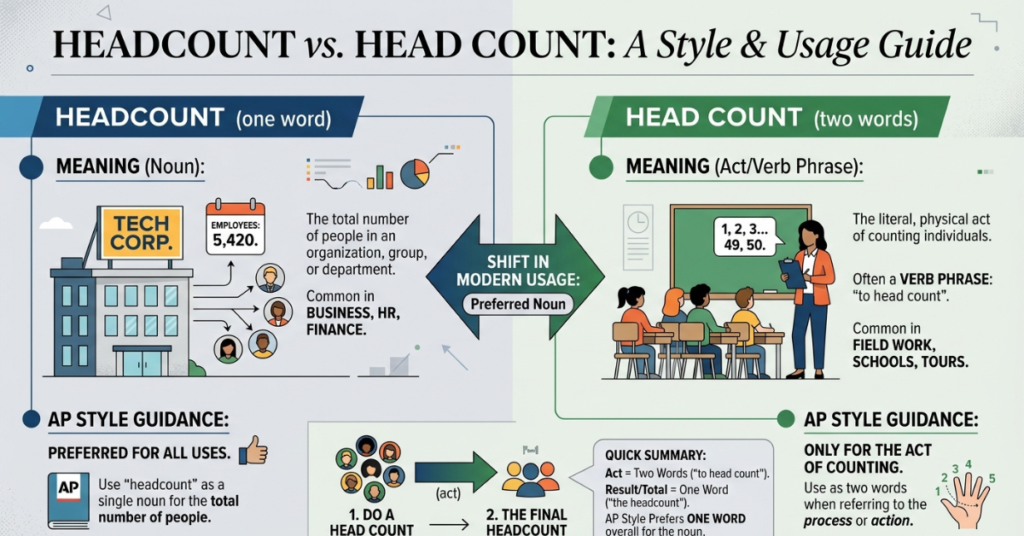

Have you ever written “headcount” and then stopped to wonder whether it should actually be “head count”? You are not alone. This is one of those everyday English terms that looks simple but can create confusion, especially in workplace writing, HR documents, business reports, and formal communication.
The phrase headcount or head count generally refers to the number of people in a group, organization, department, or workforce. However, whether you write it as one word or two can depend on how it is being used and which style guide you follow.
In this guide, we’ll explain headcount or head count meaning, look at common examples, answer “is it headcount or head count?”, and discuss headcount or head count AP style.
Headcount or Head Count: What Does It Mean?
Headcount or head count means the total number of people in a particular group or organization.
For example:
- The company increased its headcount by 20 employees.
- The manager conducted a head count before the bus left.
- Our department currently has a headcount of 15.
- The event organizer needs an accurate head count before ordering food.
The basic idea is straightforward: one “head” represents one person, and the count represents the number of people.
The term is especially common in business and workplace settings, where companies use it to discuss staffing levels, hiring, workforce planning, and employee numbers.
Is It Headcount or Head Count?
So, is it headcount or head count?
The answer is: both forms are used in English, but they are not always used in exactly the same way.
Headcount is commonly used as a noun in business and HR contexts when referring to the number of employees or members of a workforce.
The company plans to increase its headcount next year.
Head count is also correct, particularly when referring to the act of counting people or the number of people who need to be counted.
The teacher took a head count before the students entered the museum.
In modern business writing, headcount as one word is extremely common. However, head count remains an established form, particularly in general or literal contexts.
Headcount or Head Count Meaning in Business
In business, headcount usually refers to the number of employees working for an organization, department, or team.
For example, a company might say:
Our current headcount is 250 employees.
Here, headcount is essentially a measurement of workforce size.
Businesses may track headcount for several reasons, including:
- Workforce planning
- Recruitment
- Budgeting
- Payroll planning
- Department growth
- Staff reductions
- Resource allocation
- Organizational planning
A manager might say, “We don’t have the headcount to take on another project.” This means the team does not currently have enough employees to handle the additional workload.
Headcount vs. Full-Time Equivalent
One important distinction is that headcount and full-time equivalent (FTE) are not always the same thing.
Headcount counts people. FTE measures employees according to their equivalent full-time workload.
For example, suppose a company has:
- 5 full-time employees
- 4 employees working half-time
Its headcount is 9 people, but its FTE would be 7.
This distinction can matter when companies prepare budgets or analyze staffing requirements.
When to Use “Headcount”
Use headcount when you are talking about the number of people in an organization, team, department, or workforce, particularly in professional and business contexts.
Examples of “Headcount”
- The company has a global headcount of 1,000 employees.
- HR expects headcount to grow during the next quarter.
- The department needs additional headcount.
- Our current headcount is lower than it was last year.
- Management approved the budget for five additional headcount positions.
The last example is common in corporate language, although some editors may prefer wording such as “five additional positions” or “five additional employees.”
When to Use “Head Count”
Head count can work well when the phrase refers more literally to counting people.
For example:
- Please take a head count before leaving.
- The teacher performed a head count after the field trip.
- We need an accurate head count for dinner.
- The event coordinator asked for a final head count.
Here, the emphasis is often on the process of counting or confirming how many people are present.
That said, usage varies, and many dictionaries and style references recognize headcount as an established noun as well.
Headcount or Head Count AP Style
One of the most common questions is “headcount or head count AP style?”
The Associated Press Stylebook is widely used by journalists, publishers, businesses, and communications professionals. AP style generally favors clear, conventional usage and consistency.
For professional writing, it is useful to distinguish between the established business noun headcount and the more literal phrase head count.
If you’re referring to the size of a workforce, headcount is a natural choice:
The company reduced its headcount by 10%.
If you mean physically counting people, head count may be appropriate:
The teacher took a head count before the trip.
The most important point is consistency. If your organization follows a particular editorial or house style, follow that standard throughout the document.
Headcount vs. Head Count: Quick Comparison
| Form | Common Use | Example |
| Headcount | Workforce or employee numbers | The company’s headcount increased. |
| Head count | Counting or confirming people | We need a final head count. |
This is a useful general distinction, but English usage is flexible. Context and editorial preference can influence which form sounds most natural.
Why Does the Spelling Vary?
English frequently turns combinations of words into compound nouns over time.
Words that originally appeared as separate terms can eventually become hyphenated or closed compounds. This is why you may encounter variations such as:
- head count
- head-count
- headcount
The same pattern appears with many English compounds. Usage can change as a word becomes more established.
Headcount has become particularly common in corporate, HR, financial, and management language.
Headcount in HR and Recruitment
In human resources, headcount is an important workforce-planning term.
HR teams may monitor headcount to understand how many employees an organization currently has and how that number is expected to change.
For example, an HR report might include:
- Current employee headcount
- Planned headcount
- New hires
- Employee departures
- Department headcount
- Full-time and part-time employees
- Open positions
A company might have a current headcount of 80 and plan to reach 100 employees by the end of the year.
This information can help management estimate labor costs and determine whether hiring plans match business goals.
Headcount in Budgeting and Workforce Planning
Headcount is also closely connected to financial planning.
Employees represent significant costs for most organizations, including salaries, benefits, taxes, training, equipment, and other employment-related expenses.
For that reason, finance teams often ask questions such as:
- How many employees do we currently have?
- How many people do we plan to hire?
- Which departments need additional staff?
- How much will the increased headcount cost?
- Are staffing levels aligned with business growth?
A simple increase in headcount can therefore have a substantial effect on an organization’s annual budget.
Common Mistakes With Headcount
Although the term is simple, several mistakes appear frequently.
1. Assuming Only One Form Is Correct
It is not accurate to say that headcount is always correct and head count is always wrong.
Both forms appear in English, although their preferred contexts can differ.
2. Using “Headcount” When “Employees” Is Clearer
Corporate language sometimes becomes unnecessarily complicated.
Instead of:
We need additional headcount to complete the project.
You could simply write:
We need more employees to complete the project.
Neither is automatically better. The right choice depends on the audience and context.
3. Confusing Headcount With FTE
Remember that headcount measures people, while FTE measures work capacity expressed in full-time equivalents.
A part-time employee still contributes one person to headcount.
4. Switching Forms Without a Reason
If you’re writing a formal report, choose the form that fits your intended meaning and style guide, then use it consistently.
Headcount or Head Count: Examples in Sentences
Here are some natural examples:
Business:
The company’s headcount increased significantly after the expansion.
HR:
HR is reviewing headcount requirements for the next fiscal year.
Event planning:
Please provide a final head count by Friday.
School trip:
The teacher took a head count before the students boarded the bus.
Restaurant booking:
We need an accurate head count before confirming the reservation.
Workforce planning:
The manager requested additional headcount for the new project.
These examples show why context matters when choosing between the two forms.
Which One Should You Use?
If you’re unsure, think about what you’re trying to say.
Use headcount when you’re talking about:
- Employees
- Workforce size
- Staffing levels
- Corporate hiring
- HR planning
- Organizational growth
Use head count when you’re talking about:
- Counting people
- Confirming attendance
- Groups at an event
- School trips
- Physical or literal counting
This isn’t an absolute rule, but it is a practical guideline for everyday writing.
Frequently Asked Questions
Is it headcount or head count?
Both headcount and head count are used in English. Headcount is especially common when discussing employees, staffing, and workforce size, while head count is often used when referring to the act of counting people.
What is the headcount or head count meaning?
The term refers to the number of people in a particular group. In business, it usually means the number of employees in an organization, department, or team.
Is “headcount” one word?
Yes. Headcount is an established one-word spelling and is widely used, particularly in business and HR contexts.
Is “head count” grammatically correct?
Yes. Head count is also an accepted form. It is commonly used when referring to counting or confirming the number of people in a group.
Is headcount or head count AP style?
For AP-style writing, context and consistency are important. Headcount is widely used as a business noun for workforce numbers, while head count can be appropriate when referring to counting people. When writing for an organization, follow its established editorial style.
What is the difference between headcount and FTE?
Headcount counts the actual number of people. FTE (full-time equivalent) measures the equivalent amount of full-time work. Therefore, several part-time employees can increase headcount without increasing FTE by the same amount.
Can headcount refer to customers or guests?
Yes. The broader meaning can refer to the number of people in a group, including guests, attendees, or participants. However, “number of attendees” or “number of guests” may be clearer in formal writing.
Should I write “headcount” in a resume?
You can use headcount when describing professional experience involving workforce planning, team management, recruitment, or organizational growth. For example: “Managed a team with a headcount of 25 employees.”
Final Thoughts on Headcount or Head Count
So, headcount or head count—which one should you choose? The answer depends largely on context.
Headcount is particularly common in business, HR, recruitment, and workforce planning when referring to the number of employees. Head count remains a valid form and works especially naturally when talking about counting people or confirming attendance.
If you’re wondering “is it headcount or head count?”, don’t worry about treating one spelling as universally correct. Instead, consider the meaning, audience, and style guide you’re following. For headcount or head count AP style, consistency and context are key.
Once you understand that distinction, choosing the right form becomes much easier—and your professional writing will sound clearer and more natural.